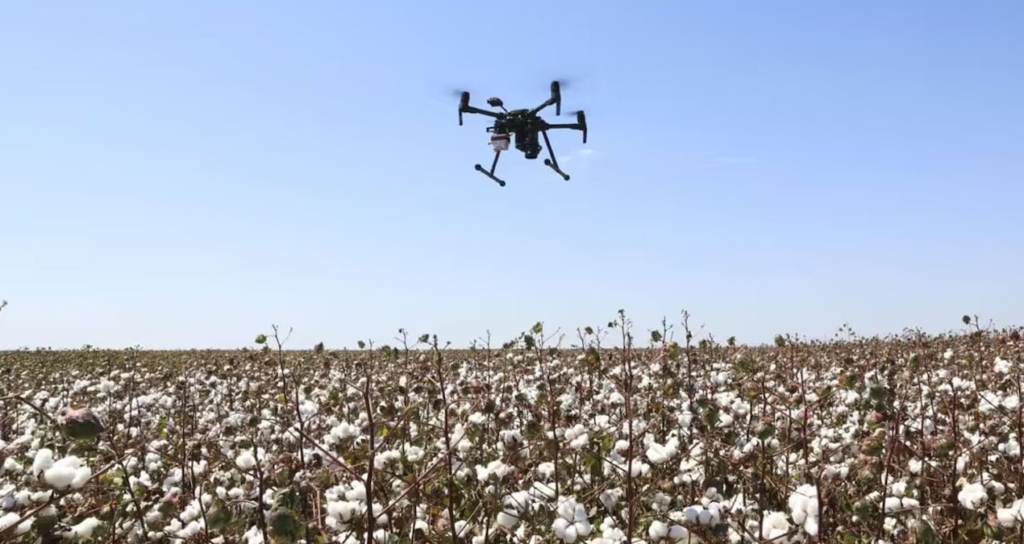
Agricultural research agency Embrapa has unveiled a drone-based dispersal system in Brazil that releases thousands of beneficial insects across cotton crops, aiming to curb pest damage while reducing dependence on synthetic chemical pesticides over an operational area of one hectare in eight minutes.
Automated Aerial Dispersal for Pest Control
Showcased during the ExpoCariri 2026 event in Ceará state, the mechanism transports parasitoids—insects whose larvae feed on and ultimately kill pest hosts—inside specialized canisters. As the unmanned aerial vehicle flies over designated agricultural plots, it drops the insects across specific zones, eliminating the requirement for manual field distribution on large-scale farms.
Data provided by Embrapa indicates that covering one hectare requires roughly 730 beneficial insects. The distribution relies on approximately 25 tubes per hectare, with each container holding 30 individual insects.
Targeting Major Crop Threats with Biological Solutions
The dispersal method specifically deploys the parasitoid species Jaliscoa grandis to suppress cotton boll weevil populations, a pest responsible for significant harvest losses. The agency noted that the same aerial platform can also distribute Trichogramma wasps to target pest caterpillars.
Research teams are simultaneously working to reduce the overhead costs associated with rearing these biocontrol agents. Trials using lower-cost, reusable equipment showed that a two-person crew could breed approximately 2,500 parasitoid insects within a week.
Embrapa stated that drone integration will not fully replace chemical pesticide applications, but will instead operate alongside routine field monitoring and broader biological control practices. The research agency is also studying insect-pathogenic fungi capable of infecting and killing pests, reporting that laboratory trials demonstrated mortality rates exceeding 80 percent among exposed insects. These biological control methods are projected to enter field deployment within three to six years.