As four astronauts prepare for a historic flight around the Moon, the mission signals a transition from exploration to a high-stakes race for resource control and permanent settlement.
In a move that mirrors the geopolitical tensions of the 1960s, NASA is set to launch the Artemis II mission, marking the first time in over half a century that humans will orbit our nearest celestial neighbor. While the Apollo missions were defined by the Cold War struggle for prestige, the $93 billion Artemis program is focused on securing “lunar real estate” and the vast mineral wealth buried beneath the Moon’s surface.
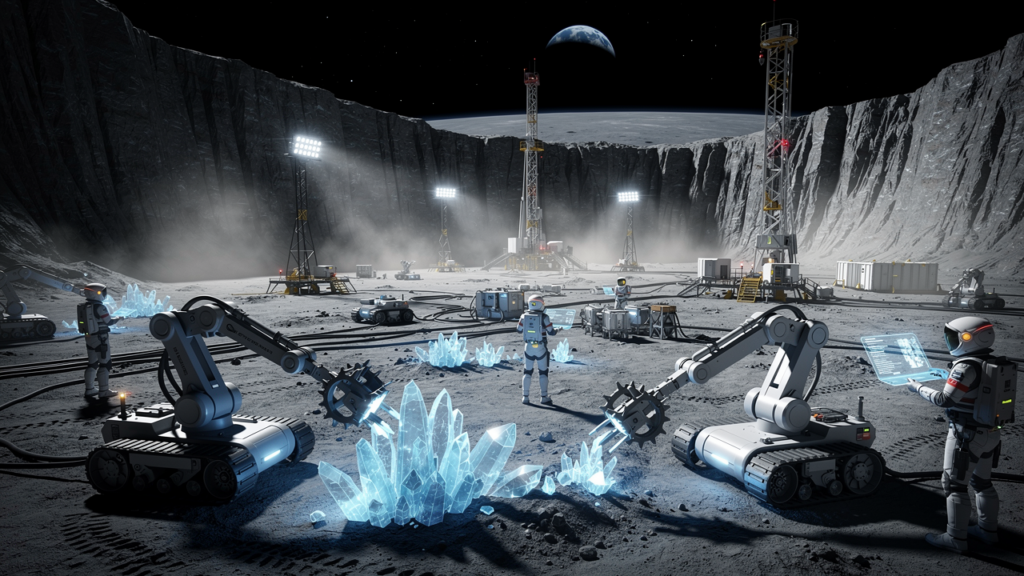
Planetary scientists suggest the Moon is far from a barren wasteland, containing essential metals and rare earth elements that are becoming increasingly scarce on Earth. Iron, titanium, and helium—critical for medical and superconducting technologies—are believed to be concentrated in specific lunar regions. However, the most contested resource is water-ice, trapped in permanently shadowed craters at the lunar poles.
“The Moon has got the same elements in it that we have here on Earth. There might be parts of the Moon where these are concentrated enough to be able to mine them,” notes Professor Sara Russell, a planetary scientist at the Natural History Museum.
The urgency of the mission is driven by a growing rivalry with China, which aims to land its own crew on the lunar surface by 2030. While international treaties prevent any nation from claiming ownership of the Moon, legal experts note that established bases grant de facto control over operational areas. Dr. Helen Sharman, the first British astronaut, explains that current efforts are focused on securing land use under a “first-come, first-served” reality.
“The big thing right now is to try to grab your piece of land. You can’t own it, but you can use it. And once you’re there, you’ve got it for as long as you want it,” Sharman says.
Beyond the immediate resource grab, Artemis II serves as a vital safety test for NASA’s long-term goal: Mars. By establishing a sustained lunar presence, the agency can develop life-support systems and radiation shielding in a relatively accessible environment. NASA officials argue that the Moon is a necessary proving ground where errors are manageable, rather than catastrophic.
SOURCES: NASA, Natural History Museum, Science Museum, United Nations Outer Space Treaty Office.
This report has been significantly transformed from original source material for journalistic purposes, falling under ‘Fair Use’ doctrine for news reporting. The content is reconstructed to provide original analysis and reporting while preserving the factual essence of the source.