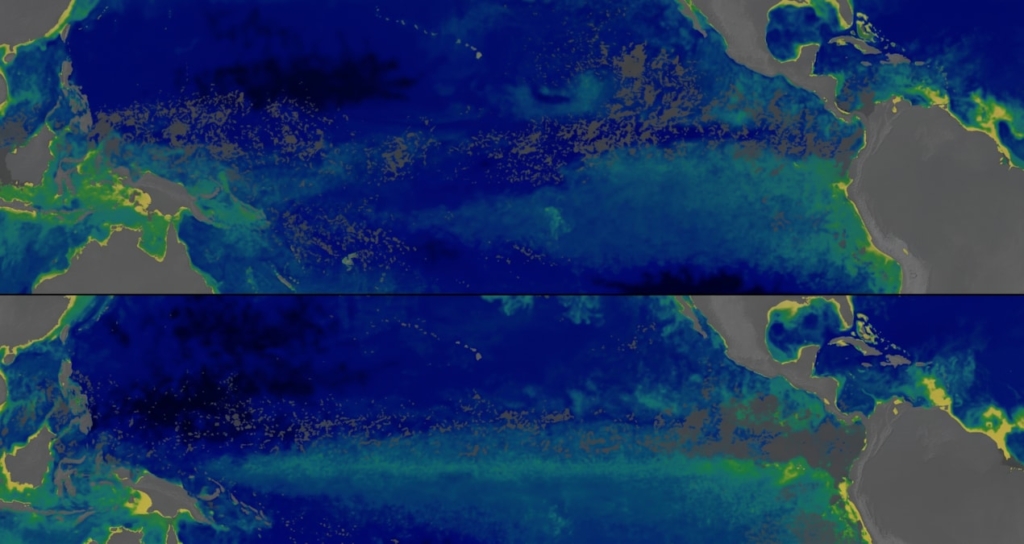
New satellite data from NASA reveals that equatorial Pacific waters have turned distinctly blue as a Super El Niño event disrupted nutrient-rich currents, starving trillions of photosynthetic plankton. The environmental shift signals a collapse at the base of the marine food chain across the region.
NASA announced:
The color of the ocean changed due to the Super El Niño effect.
Under typical conditions, ocean currents transport cold and nutrient-rich waters toward the sea surface. The thermal surge interrupted this supply mechanism, leading to the starvation of microscopic plankton that provide the waters with their emerald green tone and support the marine habitat. Following the drop in biological activity, the ocean transitioned into a deep, lifeless blue.
Real-time monitoring of the ecosystem was conducted by NASA’s advanced PACE satellite, which was launched into space in 2024. The data demonstrated a breakdown at the lowest tier of the aquatic food web.
Experts stated:
The disappearance of these tiny photosynthetic organisms will cause a chain disaster across all marine life, forcing many species from fish to marine mammals to migrate to find food.
The event originated in January in the Western Pacific via underwater waves operating as a thermal highway, fully encompassing the Eastern Pacific by April. As higher temperatures triggered thermal expansion, sea levels rose by up to 40 centimeters along the coastlines of California and South America.