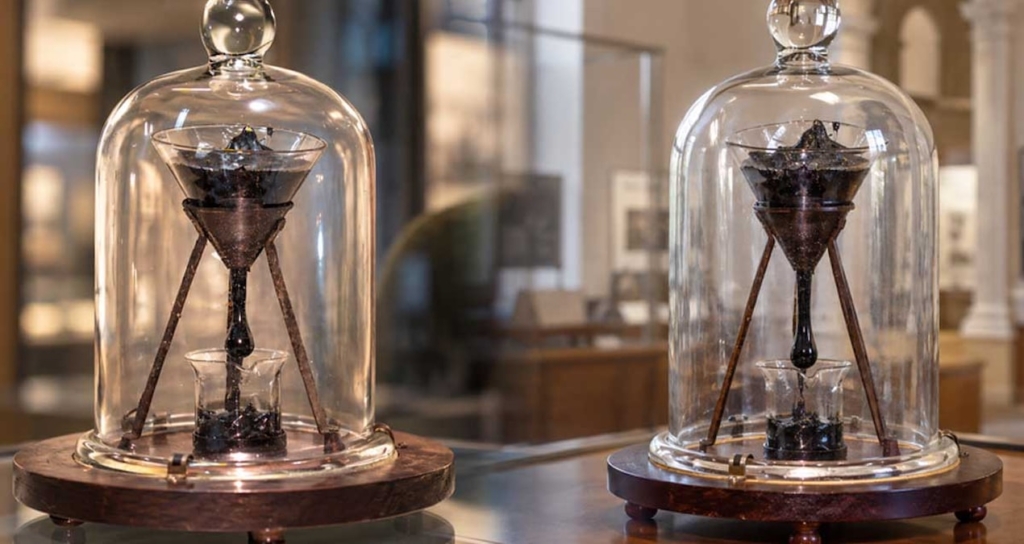
The University of Queensland is monitoring the Pitch Drop Experiment as its tenth drop approaches after nearly a century of continuous observation. Established in Australia to study hydrocarbon fluid dynamics, the Guinness World Record-holding test has yielded nine drops since 1930 without a single recorded human witness.
Hydrocarbon Fluid Dynamics and Laboratory Origins
Initiated in 1927 by Thomas Parnell, the institution’s inaugural professor of physics, the project aimed to demonstrate that rigid pitch resin remains an active liquid. Parnell heated the petroleum derivative into a sealed funnel, allowed the material to stabilize for three years, and unsealed the stem in 1930. The substance possesses a viscosity—or internal flow resistance—calculated at 230 billion times greater than liquid water, causing gravity-driven droplet development to span multiple years.
Environmental Shifts and Missed Visual Records
Ambient laboratory conditions significantly altered the flow over subsequent decades. While the initial seven droplets separated between 1938 and 1988 at intervals of seven to nine years, the installation of climate-control air conditioning lowered room temperatures, lengthening subsequent intervals to 12 or 13 years. Long-time custodian John Mainstone oversaw the experiment for 52 years yet missed the seventh drop in 1988 during a five-minute absence, while an unexpected 20-minute power failure blinded monitoring cameras during the eighth drop in 2000.
Mainstone passed away in 2013, roughly eight months before the ninth release in 2014, which detached mechanically when custodian Andrew White attempted to reposition a receiving beaker touching the mass. Recognized internationally with an Ig Nobel Prize in Physics in 2005, the apparatus now operates under round-the-clock digital surveillance as researchers anticipate the tenth release window between mid-2026 and late 2027.