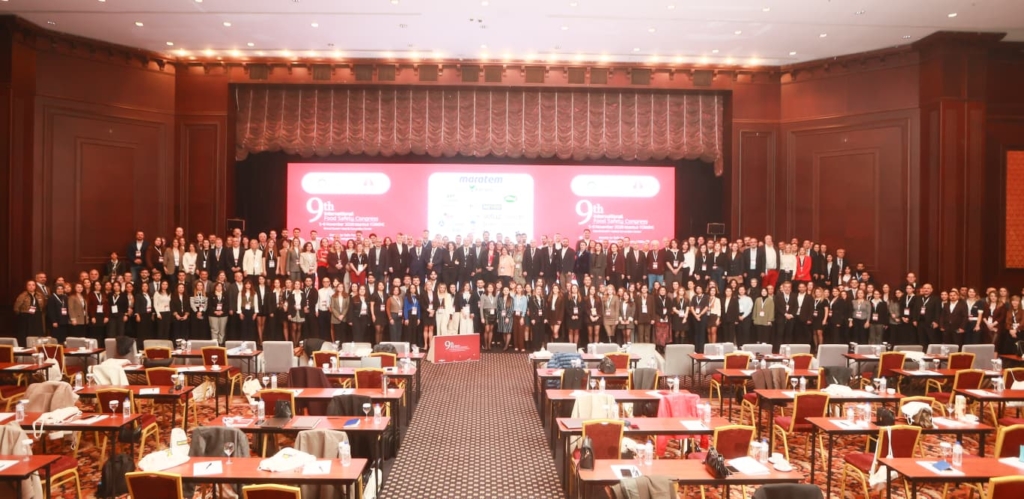
The 9th International Food Safety Congress commenced in Istanbul on November 5, bringing together roughly 400 scientists, experts, and industry delegates from 11 nations to assess scientific risks, supply chain integrity, regulatory frameworks, and technological oversight across the global food sector.
Coordinated by the Food Safety Association alongside the International Association for Food Protection (IAFP) and backed by the Ministry of Agriculture and Forestry, the biennial conference at Grand Cevahir Hotel & Convention Center is Turkey’s only congress dedicated solely to food safety. The two-day program features 12 sessions alongside 65 oral and 34 poster presentations covering regulatory processes, traceability mechanisms, and environmental parameters shaping food systems.
During the opening remarks, Selim Kaplan, Head of the Food Codex and Feed Legislation Department at the Ministry of Agriculture and Forestry, stated that food has increasingly turned into a strategic instrument of power and leverage globally, making production capacity vital. Kaplan noted Turkey meets domestic demand while exporting to nearly 200 countries through extensive industry framework and multi-stakeholder participation, adding that public awareness and food literacy remain ministry priorities since state inspection alone cannot guarantee compliance.
IAFP President Dr. Manan Sharma highlighted the organization’s network of over 4,500 food safety professionals, pointing out that advancing international collaboration and scientific knowledge exchange is essential to protect the global food supply. Sharma recognized the Food Safety Association as a central collaborator in supporting these international educational initiatives and scientific publications.
Global Economic Burdens And Predictive Technologies
Addressing the economic and public health repercussions of unsafe supply chains, Food Safety Association President Filis Gergerli cited World Health Organization figures published in 2026 showing that unsafe food caused roughly 866 million illnesses and 1.52 million fatalities in 2021, with productivity losses reaching nearly $647 billion on a purchasing power parity basis.
Food safety is an integral part of countries’ development journey. It protects health; it strengthens economic resilience, continuity in production, and confidence in international trade.
Congress President Dr. Samim Saner stated that traditional testing mechanisms must evolve toward artificial intelligence and predictive data analytics to identify emerging hazards before regulatory contamination thresholds are crossed in processing plants.
We now need food safety systems that can anticipate problems that have not yet arisen, rather than only detecting issues that have already occurred. Yesterday’s question was, ‘Is our product safe?’ Tomorrow’s question will be, ‘How early can we recognize the change that could threaten our product’s safety?’
The program also incorporated gastrophysics research presented by Prof. Charles Spence of Oxford University regarding sensory interaction, alongside sessions examining unscientific claims spreading via popular media. Scientific Advisory Board Chairman Prof. Dr. Barbaros Özer warned that unfounded claims mislead consumer dietary choices, setting the stage for a panel discussion with Prof. Dr. Ali Esat Karakaya, Prof. Dr. Taner Damcı, Prof. Dr. Murat Baş, Prof. Dr. Elgiz Yılmaz Altuntaş, and Levent Küçük on mitigating food safety misinformation.