The President utilized his annual speech to unveil a new 15% tariff strategy and confront a partially absent Supreme Court following legal setbacks.
In the longest State of the Union address in American history, President Donald Trump delivered a defiant message to a fractured Congress on Tuesday. Navigating a landscape of international tension and domestic legal hurdles, the President used the platform to reassert his economic agenda and directly challenge the judicial branch. The address comes at a critical juncture as the administration faces a pivotal midterm election season and ongoing geopolitical friction with Iran.
A central point of contention was the President’s public interaction with the Supreme Court. Following the high court’s recent decision to strike down his global tariffs, only four of the nine justices—Chief Justice John Roberts and Justices Amy Coney Barrett, Elena Kagan, and Brett Kavanaugh—attended the event. Trump specifically characterized the court’s ruling as “disappointing,” signaling his intent to bypass the decision by invoking Section 122 of the Trade Act. This rarely used provision allows for a 150-day implementation of 15% tariffs, a move Trump suggested would eventually replace federal income tax without the need for further legislative approval.
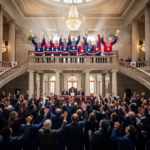
The atmosphere inside the House chamber was marked by visible partisan abandonment. Dozens of Democratic lawmakers boycotted the proceedings, leaving significant sections of the room vacant. Among those present, resistance was vocal; Representative Al Green of Texas was removed by security for the second consecutive year after displaying a protest sign, while Representative Ilhan Omar of Minnesota repeatedly interjected to challenge the President’s assertions regarding immigration and alleged regional fraud.
Patriotism and the National Agenda
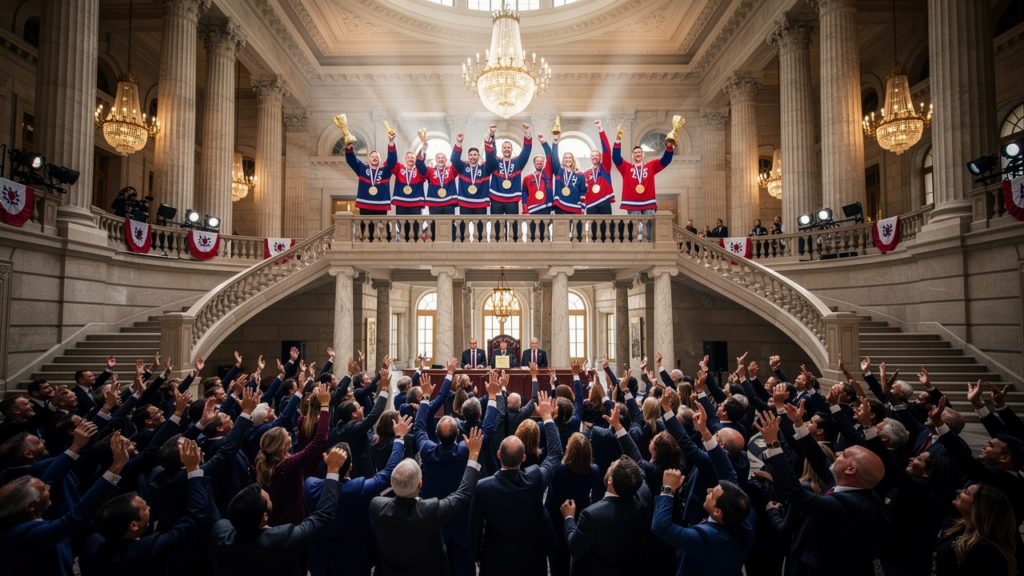
The evening was punctuated by a highly choreographed appearance by the U.S. Men’s Hockey Team, fresh from their Olympic gold-medal victory over Canada. Trump announced that goalie Connor Hellebuyck would receive the Presidential Medal of Freedom, the nation’s highest civilian honor. This display of national pride served as a backdrop for the President’s more combative policy stances, including a direct challenge to lawmakers to prioritize citizens over undocumented residents, a move that prompted a starkly divided physical response from the audience.
SOURCES: The White House, U.S. Congress, U.S. Supreme Court, PA Media.
This report has been significantly transformed from original source material for journalistic purposes, falling under ‘Fair Use’ doctrine for news reporting. The content is reconstructed to provide original analysis and reporting while preserving the factual essence of the source.